The recent rise of public awareness surrounding societal breakdown has prompted a search for holistic solutions. Although, I am referencing what we are facing in Fiji (particularly the Indigenous Fijian community), the fact that this is a global issue could very well mean that maybe what I share next could have global implications as well. I preface this article by stating that I am a proud Indigenous Fijian (Koro, Lomaiviti kei Oneata, Lau) and Rotuman (Avave, Pepjei); with training in Psychology (Business & Indigenous Psychology).
Recently, a prominent Indigenous Fijian politician, Lenora Qereqeretabua, lamented on what is happening in our communities, specifically Indigenous Fijian communities, quoting “o keda tiko ga (sic) na itaukei/it is always the Indigenous“.
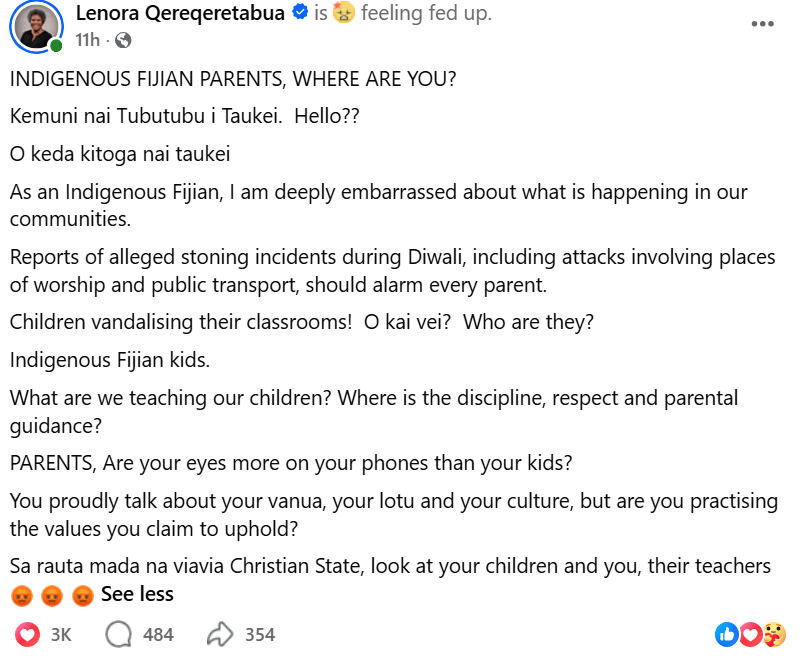
My train of thoughts immediately arrived at its destination and what is the central contribution of this article: Community-centered cultures require collective-based solutions.
Home-Centered Growth Model
When discussion around addressing youth problems arises, two common opinions are usually presented by Indigenous Fijians:
- Allow the return corporal punishment in schools and homes.
- Necessity for Fiji to become a “Christian State”.
I would first ask: How much time are we spending with our youth to impart values and culture?
In 2018, my church leaders introduced a new approach that shifted the primary responsibility for gospel instruction and spiritual growth from church meetings to individuals and families in their own homes. The model was labeled Home-Centered, Church Supported.
The Home-Centered component reemphasized the home as a spiritual sanctuary of faith where daily individual and family scripture study, prayer, and family-centered home evenings are encouraged. The Church-Supported component meant church meetings and classes existed to reinforce, support, and supplement what was already being taught and learnt at home.
Now how does this tie back to my argument?
We need to implement a similar model in our societies.
Emphasize the importance of parents, guardians, and community leaders in spending real, meaningful time to teach cultural and spiritual values to our youth. We cannot expect systems outside of our homes, villages, communities, to teach these principles for us. These external systems are there to reinforce, support, and supplement what is already being taught and learnt at home. The education system is meant to educated our youth on how to navigate the western model of learning; the law enforcement system is there to enforce national law; social welfare systems are there to help the less fortunate. These external systems cannot and should not be replacements for the primary center of learning and growth:
Home-Centered, System Supported.
Collective Approaches to Enforcing Values
In the book A Kind of Mending: Restorative Justice in the Pacific Islands, Dr. Alumita Durutalo contributed a chapter titled Informal Justice in Law and Justice Reform in the Pacific Region, that voiced her concerns that neither the colonial-rooted rule of law or traditional conflict resolution methods can effectively address modern issues. Durutalo suggested a selective integration of traditional and state-based structures and their methods of dealing could better suit the well-being of communities.
She argued that indigenous social structures from the itokatoka (extended family units) to the Vanua (socio-cultural-ecological structures) defined the boundaries in which social relations were organised, articulated and interpreted within Indigenous Fijian communities. People lived according to customs and expected norms of behaviour which were not written down in a constitution or books of law. Their oral customs and traditions, which were practised within the confines of socio-political structures, had been able to sustain Indigenous Fijians from one generation to another for thousands of years. Customs and traditions still regulate the lives of individuals in many parts of Fiji from the moment of birth until death. An individual is born into a gradation of social units which range from the iTokatoka to the Vanua.
According to Durutalo, the customary way of solving conflicts is not intended to punish and simultaneously alienate the wrongdoer from the rest of the community. While the perpetrators of wrong actions recognise that they are at fault, they are also being helped by the community to reform and live according to the norms of society.
And that is where, I believe, we need to return: emphasising collective approaches to enforcing values and reformation.
The grey area between customary and modern justice has been a ‘death trap’ mostly for youths in Fijian society. Fijian youths who face trial in the modern legal justice system are often left to fend for themselves when seeking legal advice even for petty offences. Once convicted, the cycle continues and it is quite difficult for them to return to the norms of Fijian communities largely because there are currently no avenues available to assist them. – Alumita Durutalo
Utilise the Vanua group units—Vuvale (family), iTokatoka, Mataqali (clan), and Yavusa (Tribe)—in implementing and reinforcing values. Identify perpetrators and their family units and recruit their help in the reformation process. We cannot alienate individuals and wash our hands off of them.
The same can be said about prevention and intervention programs. These initiatives require a collective approach that integrates traditional collective units to ensure success, real success. Which leads to the question of what can collectives do address societal issues?
Application, Assistance, and Apparitions
Where does the Home-Centered Growth Model and Collective Approaches intersect?
Everything begins at home. The inspired transition toward home-centered, church supported spiritual growth represents where we should focus our efforts. In the Pasifika (and other indigenous communities) context, home-centered doesn’t necessarily mean the nuclear family. I would advocate that home-centered teaching and growth means involving collective group units in teaching and governing values. We cannot simply expect nuclear family units, a growing majority who are without one or both parental models, to carry the burden of our future generation.
The cognitive dissonance (AKA disconnect) between how our society is built and how we are expected to handle societal issues is glaring! We are expected to contribute to the collective good, while the collective activate a “hands-off” policy toward addressing social issues.
How much of societal ills could be effectively addressed if the collective (extended family; clan, tribes, and elders) led reformation processes? How impactful would crime prevention initiatives be if the group units were active participants in its implementation?
These are two questions that theoretical exercises like this one cannot truly answer. This is a speculation! The next question would then be, who do we need to bring to the table to provide actionable next steps?


Leave a Reply